
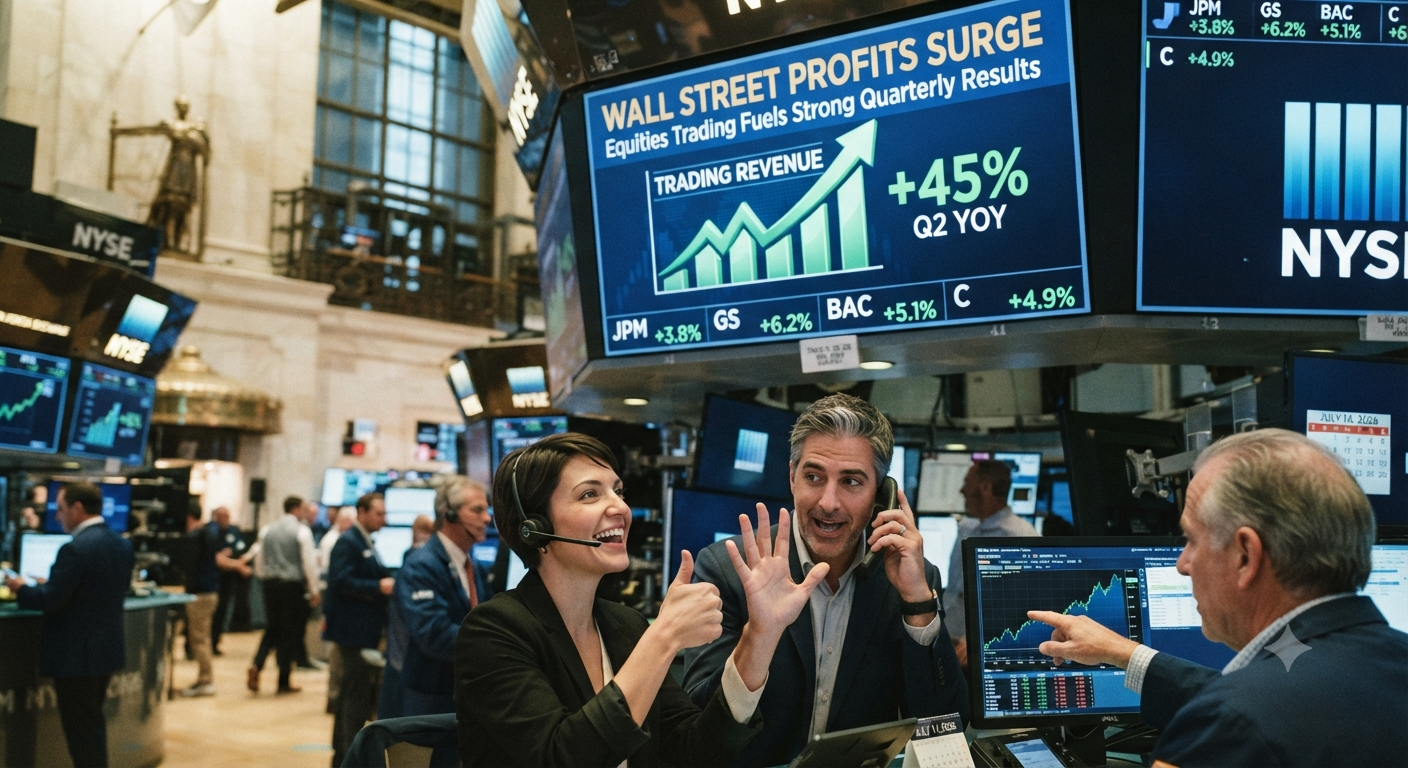
In a display of remarkable financial resilience, America’s largest financial institutions have delivered a series of blowout second-quarter earnings reports for 2026, significantly surpassing Wall Street forecasts. Driven by a convergence of high market volatility, the booming artificial intelligence (AI) sector, and a wave of blockbuster initial public offerings (IPOs), major banks have capitalized on an environment characterized by intense dealmaking and active trading desks.
A Record-Breaking Quarter
The second quarter of 2026 has been defined by a “booming environment” for equities, with banking giants reporting results that have left analysts’ expectations far behind.
- JPMorgan Chase set the pace for the industry, reporting a record-setting quarterly profit of $21.2 billion, supported by robust consumer spending and corporate dealmaking.
- Goldman Sachs delivered an earnings per share (EPS) of $20.98, shattering the consensus estimate of $14.48 by roughly 45%, while revenue reached $20.34 billion against a $16.13 billion forecast.
- Bank of America reported strong broad-based revenue growth, with EPS of $1.21 on $31.7 billion in revenue, driven notably by a 70% jump in equities trading revenue to a record $3.6 billion.
- Citigroup reported its highest quarterly revenue in a decade, with EPS of $3.15, beating the $2.74 forecast.
- Wells Fargo also outperformed expectations, posting an EPS of $2.00 against the $1.72 estimate, with revenue of $22.62 billion.
The Drivers: AI, IPOs, and Volatility
The financial success of these institutions is not accidental; it is the result of capitalizing on three specific pillars of 2026 market dynamics.
1. The AI Super-Cycle
Artificial intelligence has become a primary engine for corporate activity. The ongoing “AI super-cycle” has stimulated demand for capital, debt financing, and equity issuance as companies seek to fund large-scale infrastructure projects. This capital-intensive environment has been a boon for investment banking divisions, which are seeing their highest fee levels since 2021.
2. High-Profile Dealmaking
Investment banking activity has surged, fueled by multibillion-dollar transactions and mega equity offerings. A significant contributor was the SpaceX IPO, which raised roughly $86 billion and netted the involved investment banks approximately $500 million in fees. Such big-ticket deals have reinvigorated the market, signaling the most bullish dealmaking environment in years.
3. Market Volatility as a Revenue Engine
While geopolitical conflicts—including tensions in the Middle East—have created economic uncertainty, they have also injected the “higher-than-usual volatility” that trading desks rely on to generate revenue. This volatility, combined with the AI-driven disruption, has kept markets active and liquid, allowing traders to capitalize on price swings across various asset classes.
Caution Amid the Gains
Despite the “terrific global markets performance,” bank executives remain cognizant of the broader economic landscape. While consumer credit quality is holding steady, there are underlying risks to the global economy. Factors such as geopolitical fragmentation, potential energy bottlenecks, and the lingering effects of inflation continue to complicate the outlook for the second half of the year.
Furthermore, the mortgage industry remains in a “murkier” position, as high rates continue to weigh on the housing market, with 30-year fixed rates hovering near 6.5%.
Looking Ahead
Despite these challenges, the environment remains constructive for the major banks. With demand for loans expected to grow by approximately 10% in 2026 and a strong pipeline of business activity, banks are positioned to benefit from the ongoing demand for capital. For now, Wall Street is enjoying the fruits of a booming equity environment—a testament to the industry’s ability to adapt and thrive in an age of rapid technological and geopolitical change.










Leave a Reply