
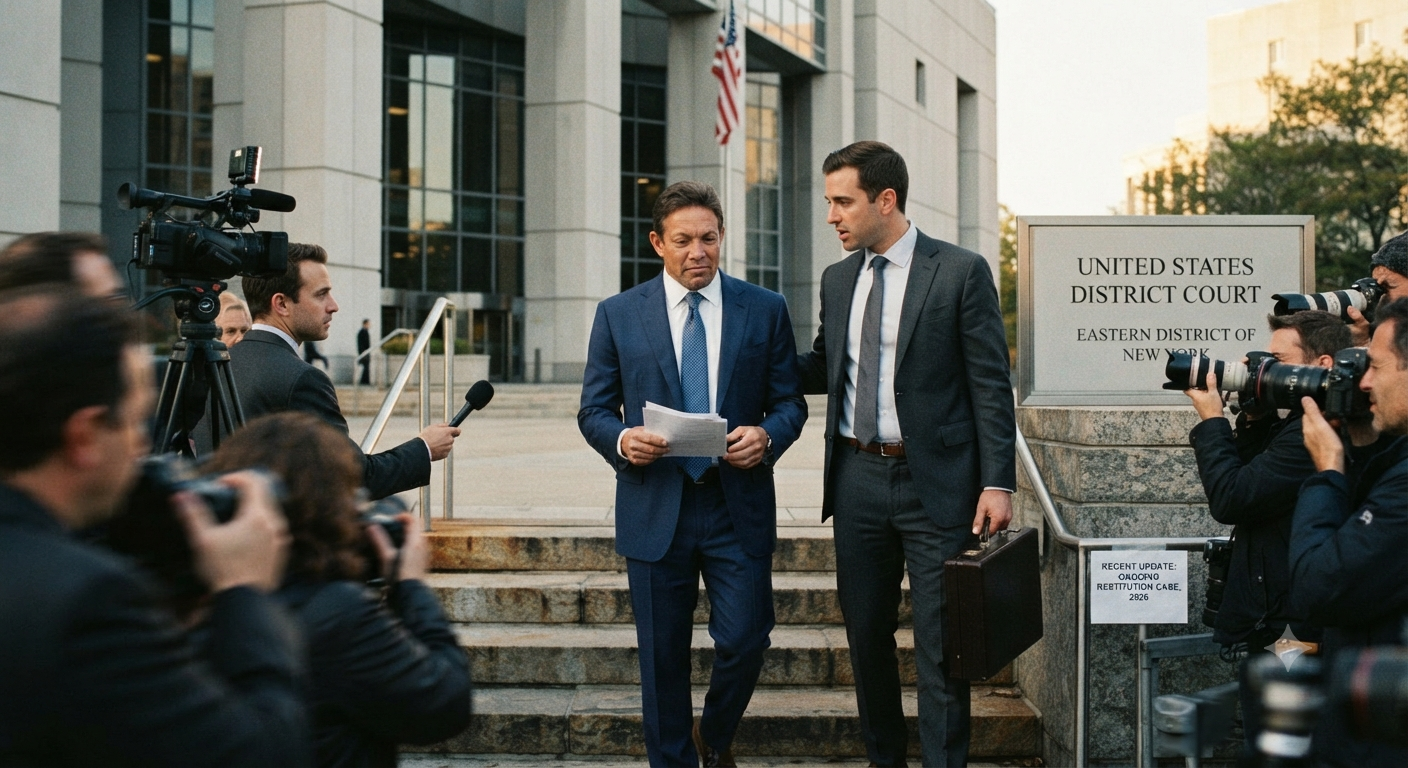
The narrative of Jordan Belfort—the “Wolf of Wall Street”—is one of the most polarizing financial tales of the modern era. While his life has been dramatized in memoirs and a blockbuster film, his legal standing remains anchored in a significant, ongoing obligation to the victims of his crimes. Decades after his conviction for securities fraud and money laundering, Belfort continues to navigate a lifetime court-ordered restitution mandate, a reality that stands in stark contrast to the glitz of his cinematic portrayal.
The Genesis of a $110 Million Debt
In the 1990s, Belfort’s brokerage firm, Stratton Oakmont, engaged in widespread securities fraud, swindling approximately 1,513 clients out of hundreds of millions of dollars. Following his 1999 guilty plea, Belfort was sentenced in 2003, at which time a federal judge ordered him to pay $110.4 million in restitution to his victims.
For years, the status of this debt has been a point of intense public and legal scrutiny. Prosecutors and victims’ advocates have frequently highlighted the gap between the total amount owed and the actual funds distributed to investors. As of various points in the last decade, Belfort was reported to have paid only a fraction of the $110 million total, with much of the recovered money coming from the forfeiture and sale of his personal property rather than his own post-prison earnings.
The Legal Battle Over Payments

The structure of Belfort’s restitution payments has shifted over time, leading to significant legal friction. Initially, Belfort was required to divert 50% of his gross monthly income to the victims’ fund. However, this requirement was tied to the duration of his supervised release, which concluded in 2009.
When his parole ended, Belfort and his legal team argued that his obligation to contribute 50% of his earnings ceased. This sparked a protracted conflict with federal prosecutors, who sought to ensure that Belfort continued to contribute his substantial income—derived from lucrative public speaking engagements, books, and media royalties—toward the restitution total.
Ultimately, the dispute led to a court-mediated compromise. A judge ruled that while Belfort was no longer bound by the 50% income rule, he remained under a lifetime order to pay a minimum of $10,000 per month toward his restitution.
Profiting from Infamy: The “Wolf” Paradox
A recurring point of public frustration is the perceived irony that Belfort has built a successful second career as a motivational speaker and investment consultant—often leveraging the very fame he gained from his criminal past—while many of his original victims have struggled to recover their losses.
Critics argue that Belfort’s ability to generate wealth through books like The Wolf of Wall Street and Catching the Wolf of Wall Street, as well as high-profile speaking tours, should necessitate a higher level of financial contribution to his victims. In 2013 and 2014, when The Wolf of Wall Street film was released, there was a public outcry regarding the flow of royalties from the project. Belfort claimed he offered to donate 100% of his book and film royalties to the victims, but this assertion was disputed by federal authorities, who noted that he had received substantial funds from these projects with only a small portion directed toward the restitution pool.
Maintaining Accountability
Despite the passage of time, the U.S. government has periodically reaffirmed its commitment to the restitution order. Garnishment hearings and court interventions have served to keep the debt in the public eye, with federal judges consistently reminding Belfort’s legal counsel that the primary goal remains to get the victims’ restitution “back on track”.
For the hundreds of investors who lost their life savings to Stratton Oakmont, the process of recovery has been slow and often disheartening. Many have expressed that no amount of money could fully compensate for the personal and financial devastation caused by the fraud. Meanwhile, for Belfort, the restitution order represents a permanent tether to his past—a lifelong financial obligation that remains a central, unresolved chapter of his story.
As of 2026, the question of whether victims will ever see the full $110 million remains open. What is certain, however, is that the legal mandate remains in effect, ensuring that Jordan Belfort’s name is tied not just to the fortune he once stole, but to the ongoing, decades-long effort to repay it.









Leave a Reply