
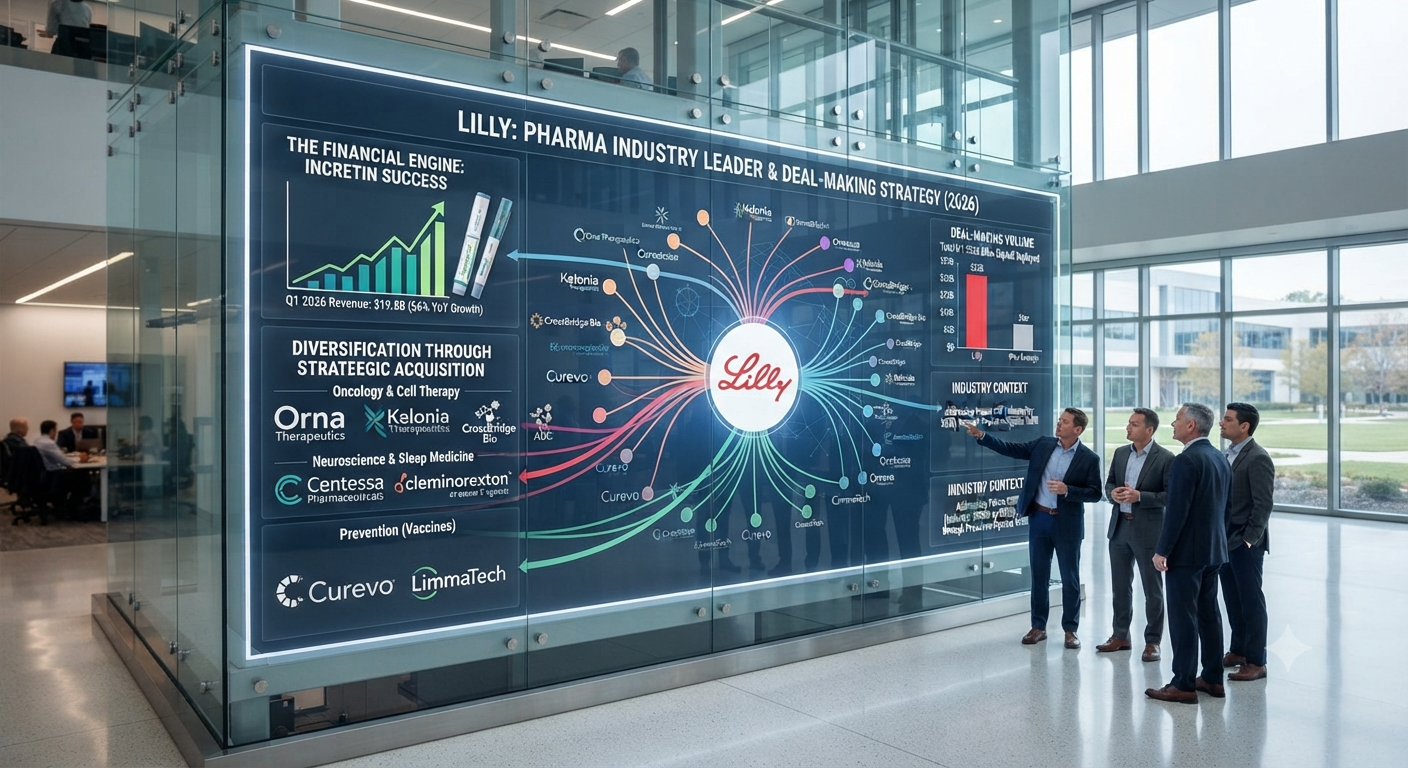
In the rapidly shifting landscape of the 2026 pharmaceutical industry, Eli Lilly and Company stands as a transformative force. Driven by a massive influx of cash from its market-leading incretin portfolio, Lilly has engaged in an aggressive campaign of business development, spending over $25 billion across roughly 10 acquisitions in the first half of 2026 alone. This spending spree, which accounts for more than half of the total M&A capital deployed by the top 12 pharmaceutical companies this year, signals a deliberate evolution in the company’s long-term strategy.
The Financial Engine: Incretin Success
Lilly’s ability to command such a dominant position in the M&A market is directly tied to the unprecedented commercial success of its cardiometabolic franchise. During the first quarter of 2026, the company reported revenue of $19.8 billion, representing a 56% year-over-year increase. Incretin revenue, led by Zepbound and the newly approved oral GLP-1 drug Foundayo, grew 90% during that same period.
This financial windfall has effectively repositioned Lilly as a “global utility” for cardiometabolic health. With Zepbound alone posting $4.2 billion in sales in the first quarter of 2026, the company has secured a 60.1% share of the U.S. incretin analogs market. By successfully launching Foundayo, the first oral GLP-1 therapy for obesity, Lilly has further expanded its addressable patient population by removing many of the barriers associated with injectable treatments.
Diversification Through Strategic Acquisition
While its GLP-1 drugs remain the “engine” of its growth, Lilly’s management has been clear about its intentions to invest in future medical breakthroughs regardless of whether those projects stem from existing platforms. The current deal-making strategy is characterized by a “triple play” approach—acquiring high-potential biotechs to deepen its pipeline in four key therapeutic areas: oncology, immunology, neuroscience, and infectious disease.
Expanding Oncology and Cell Therapy
Lilly has made significant investments in next-generation oncology and cell therapy platforms to ensure long-term resilience. Notable acquisitions include:
- Orna Therapeutics: Acquired for up to $2.4 billion, this company specializes in in vivo chimeric antigen receptor (CAR) T cell therapies for autoimmune diseases, sidestepping the manufacturing complexities of traditional ex vivo approaches.
- Kelonia Therapeutics: In a deal valued at up to $7 billion, Lilly gained access to an in vivo CAR T platform targeting multiple myeloma.
- CrossBridge Bio: Acquired for up to $300 million, this deal provides Lilly with a proprietary antibody-drug conjugate (ADC) platform designed for precision cancer treatment.
- Ajax Therapeutics: A $2.3 billion acquisition that adds a next-generation Type II JAK2 inhibitor, currently in Phase 1 trials for myelofibrosis, to Lilly’s blood cancer portfolio.
Neuroscience and Sleep Medicine
Perhaps the most significant reshuffling of its portfolio came with the acquisition of Centessa Pharmaceuticals for a total potential value of $7.8 billion. This move grants Lilly access to cleminorexton, an oral orexin 2 receptor agonist being investigated for narcolepsy and idiopathic hypersomnia. Analysts view this as a potential “game-changer” that establishes an entirely new franchise within the company.
A Pivot Toward Prevention
In a strategic shift toward disease prevention, Lilly recently agreed to acquire three infectious disease companies in a single day: Curevo, LimmaTech, and a third vaccine-focused firm. These acquisitions aim to address critical gaps in current prevention methods, such as non-mRNA shingles vaccines and prophylactic vaccines for difficult bacterial and viral pathogens, including Epstein-Barr Virus (EBV).
Industry Context and Future Outlook
Lilly’s activity is part of a broader “M&A comeback” in the pharmaceutical sector, with over 50 total transactions recorded in the first half of 2026. As major companies face a potential “patent cliff” that could strip away $300 billion in industry value by 2030, the pressure to refill pipelines through acquisition has become critical.
Unlike many of its peers, Lilly is not expected to face significant exposure from patent expirations in the near term. Instead, its aggressive strategy is driven by its current capital strength. By scaling its operations and investing in diverse modalities, Lilly is successfully operating more like a high-end tech firm than a traditional pharmaceutical company.
Looking toward the end of 2026, the company’s trajectory is supported by improving drug access, manufacturing scale-up, and a robust pipeline. With its latest series of deals, Eli Lilly has signaled that it is no longer just a drug manufacturer; it is a diversified powerhouse positioned to lead the industry for the next decade.











Leave a Reply